
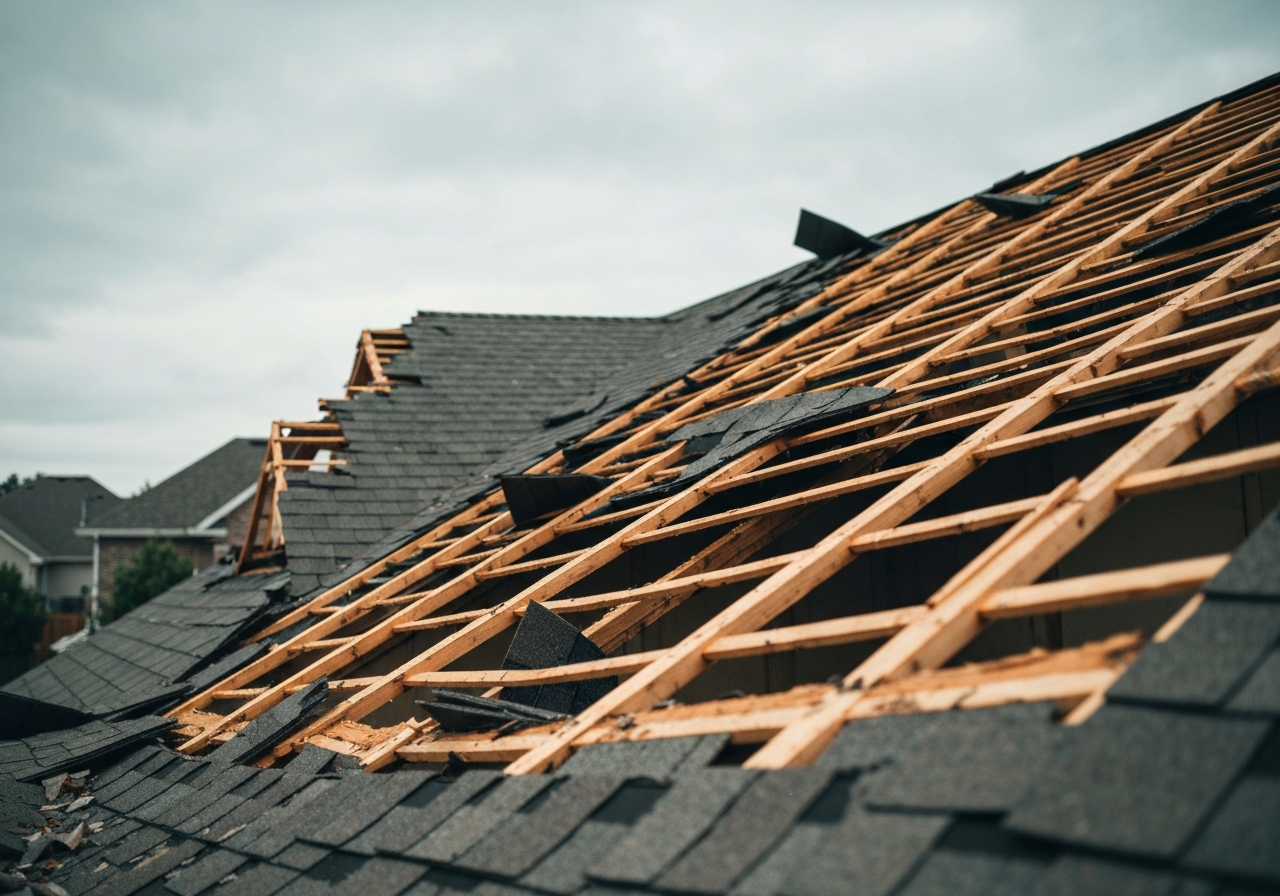
A severe hailstorm doesn't have to leave your roof covered in obvious holes or missing shingles to create a problem. Some of the most important damage can be subtle. Hail impacts can dislodge roofing granules, bruise or fracture the reinforcing material beneath the shingle surface, and weaken the roof's ability to shed water. Some damage may be difficult—or impossible—to accurately evaluate from the ground.
That's why a roof that looks fine after a storm isn't necessarily a roof that is fine. The National Roofing Contractors Association notes that hail damage can include granule loss, fractures, punctures and even damage to underlying roof components, and that visual observation alone may not reveal all significant damage.
Why Ground-Level Inspection Isn't Enough
After a storm, most homeowners naturally look up at their roof. You may see no missing shingles, no obvious holes, no large pieces of roofing material in the yard, no visible leaks, and no dramatic damage. And it is tempting to assume everything is okay.
The problem is that you're only seeing the roof from a distance. A hail impact can create a localized damaged area that isn't obvious from the ground. On asphalt shingles, functional hail damage may involve a fracture or bruise in the shingle's reinforcing mat, sometimes accompanied by significant granule displacement. Some fractures may be difficult to see from above and can be identified by examining or feeling the affected area during a professional inspection.
The Key Distinction
A roof doesn't have to look destroyed to have been damaged.
What Hail Actually Does to a Shingle
Think of an asphalt shingle as more than the colored surface you see from your driveway. The shingle contains a reinforcing mat, asphalt layers and mineral granules. Those components work together to protect the roof system and shed water. When sufficiently large or forceful hail strikes the roof, the impact can:
- Displace roofing granules.
- Bruise the shingle.
- Fracture the reinforcing material.
- Expose underlying asphalt.
- Reduce the shingle's ability to perform as intended.
- Create a pathway for moisture to penetrate the roofing system when functional damage is present.
The important distinction is that not every instance of granule loss is functional hail damage. Normal weathering, foot traffic, manufacturing issues and other causes can also produce granule loss. A professional inspection is needed to determine whether observed damage is actually storm-related.
The Problem Isn't Always Immediate
This is where homeowners can get caught off guard. A storm can happen on Saturday. You can look at your roof on Sunday and see nothing alarming. Then weeks or months later, you may begin noticing:
- A ceiling stain
- Damp insulation
- Water around a roof penetration
- Discolored decking
- A musty smell in the attic
- Peeling paint
- Moisture around an exterior wall
- An unexplained leak during the next heavy rain
That doesn't necessarily mean the roof suddenly failed. The storm may have compromised part of the roofing system earlier, with subsequent weather exposing the weakness. Research and field assessments have documented that substantial hail damage can threaten a roof system's waterproofing integrity and service life, while some damage to underlying components may not be apparent through simple visual observation.
Could Hail Damage Lead to Roof Deck Rot?
It can—but there is no universal "12-month" clock. If hail causes functional damage that allows water to enter the roofing system, repeated moisture exposure can eventually contribute to deterioration of underlying materials, including roof decking. How quickly that happens depends on numerous factors:
- The severity and location of the damage
- How much water reaches the affected area
- Roof ventilation
- Weather conditions
- The condition and age of the roof
- The type of roofing system
- Whether the damage is repaired
- How frequently the area is exposed to rain or melting snow
Homeowner Tip: Waiting for a leak before investigating storm damage isn't the best strategy. The absence of an interior leak doesn't prove the absence of roof damage.
Hail Damage Isn't Always Obvious
One of the biggest mistakes homeowners make after a storm is looking only for dramatic damage. Missing shingles are obvious. A tree through the roof is obvious. A large hole is obvious. But storm damage can also be much more localized.
The NRCA's hail-damage assessment guidance emphasizes examining roof slopes systematically and distinguishing hail damage from normal weathering, installation-related damage and other conditions. That distinction matters. You don't want someone telling you that your roof needs to be replaced simply because they found a few loose granules. But you also don't want to dismiss legitimate damage simply because your roof looks normal from the driveway.
“The goal isn't to find damage. The goal is to determine the actual condition of the roof.”
What Homeowners Should Do After a Hailstorm
If your property has recently experienced significant hail, there are a few simple steps you can take.
1. Look from the ground
Check for obvious signs such as missing or displaced shingles, damaged gutters or downspouts, dents in metal components, broken exterior fixtures, and debris around the property. Ground-level observation is appropriate for homeowners. The NRCA specifically advises homeowners not to climb onto their roofs to perform their own damage assessment.
2. Check your attic
If it is safe to do so, look for obvious signs of moisture intrusion from inside the attic. Look for water stains, damp insulation, discoloration, and signs of previous leakage.
3. Don't assume "no leak" means "no damage"
A roof can have storm-related damage without producing an immediate interior leak.
4. Have the roof professionally inspected
A trained roofing professional can evaluate the roof surface and relevant components more closely than a homeowner can from ground level.
5. Document the storm
If you believe your property has suffered storm damage, photograph visible damage and keep records of when the storm occurred.
Don't Wait for the Leak to Tell You Something Is Wrong
Your roof's job is to protect everything underneath it. You shouldn't have to wait for water to appear on your ceiling before asking whether a recent storm affected that protection. If your home has recently experienced hail or severe weather, a professional inspection can give you something much more valuable than a guess: an understanding of what your roof actually needs.
And sometimes, the best outcome of an inspection is discovering that your roof doesn't need major work. That's exactly why Roofsters approaches storm inspections with a focus on understanding the condition of the roof—not automatically selling a replacement.
Has Your Home Recently Been Hit by Hail?
Roofsters serves homeowners throughout Pennsylvania, New Jersey, Delaware and Maryland. Don't wait for a leak to become your first indication that something happened. Schedule your free inspection today.
Frequently Asked Questions
Explore Storm Restoration
Has your home recently been hit by hail? Our free inspection documents the damage you can't see from the ground—and we meet with your adjuster to advocate for your home.